
Manage scheduled content#
Scheduled Content is the single place to see and control every schedule in the workspace. It shows a grid of all schedules, a master on/off switch, at-a-glance health cards, and per-row actions to run, edit, enable, or delete a schedule. It is where you monitor whether automated runs are on time and healthy.
When to use it. As your daily check on automated distribution, and whenever you add, pause, run, or retire a schedule. What you see is trimmed by your role, so you view only the schedules and jobs your permissions allow.
Read the schedules grid#
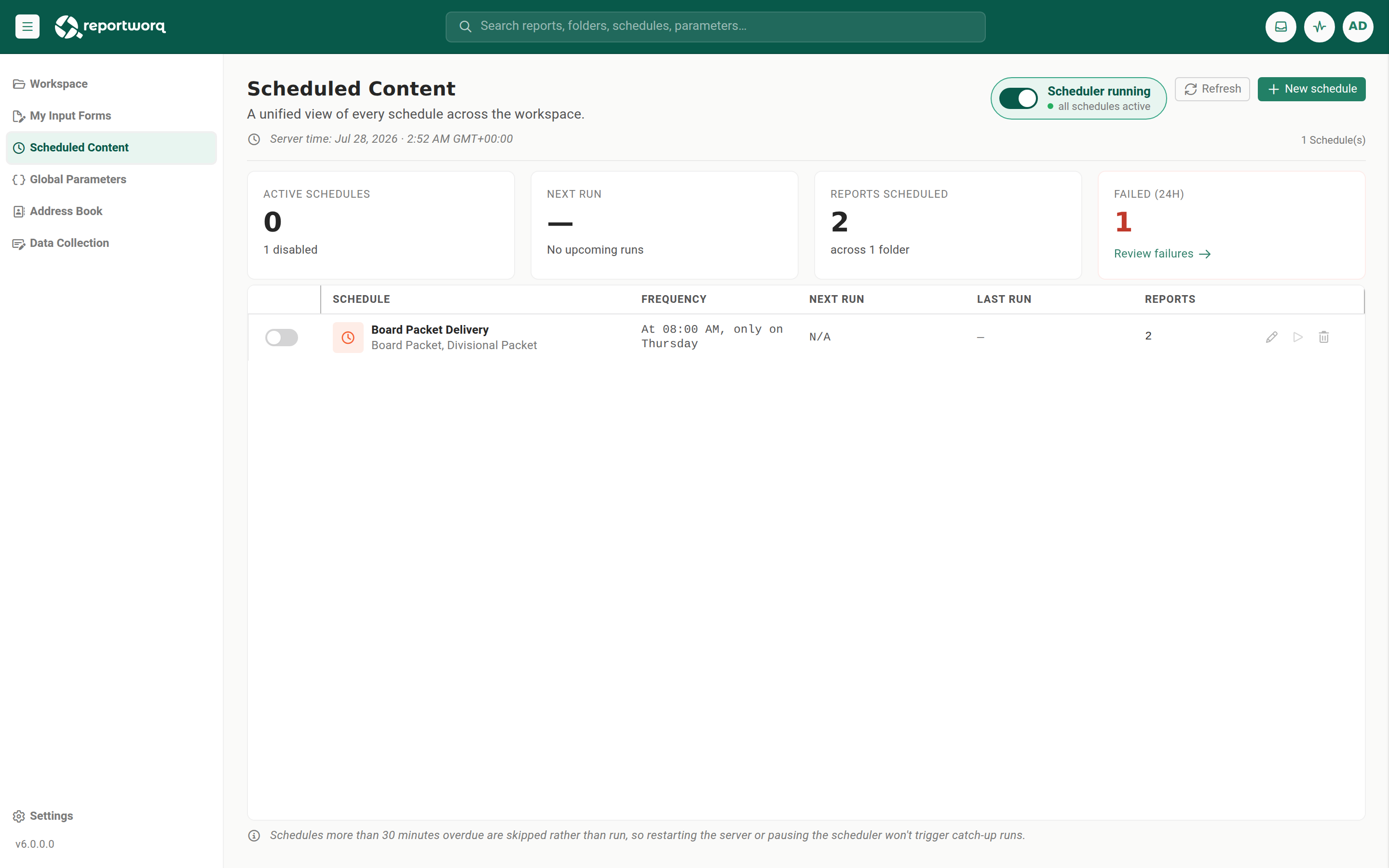
Open Scheduled Content from the side rail. Each row is one schedule, with these columns:
- Enabled toggle, Schedule (name), Frequency (the cron's plain-language description), Next Run, Last Run (the last actual run), and Reports.
- All times are shown in server time, noted above the list.
Row actions include Run now and Delete. Selecting a row opens the Schedule editor.
Turn the master scheduler on or off#
The master scheduler switch in the top-right header is the global gate for all scheduling. A schedule runs only when the master switch is on and that schedule's own enabled toggle is on.
- In the header toolbar, find the labeled switch. On it reads "Scheduler running / all schedules active"; off it reads "Scheduler paused / no schedules will run."
- To pause everything, turn the switch off and confirm in the Pause Scheduler dialog. While paused, the grid also shows an inline note that no schedules will run until you resume.
- To resume, turn the switch back on.
When to use it. Pause the master scheduler as a single, reversible kill switch during a maintenance window, a source-system upgrade, or a month-end cutover, so no automated run fires against a system that is offline or mid-change. Resume it when you are done. To stop just one schedule, use that schedule's own enabled toggle instead. The master scheduler defaults to on.
Only users with scheduler-management permission see the operable switch. Others see a read-only "Scheduler paused" indicator when it is off.
Run, edit, enable, or delete a schedule#
- Run on demand. Select Run now on a schedule's row to run it immediately without waiting for the next occurrence, for example after correcting data that needs to be redistributed now.
- Edit. Select the row to open the Schedule editor.
- Pause one schedule. Turn its Enabled toggle off. It is kept but does not run.
- Delete. Use the row's Delete action. Deleting prompts a confirmation before it removes the schedule.
Check schedule health#
A row of stat cards summarizes health: Active schedules, Next run (ETA), Reports scheduled, and a run-outcome card. When any run failed in the last 24 hours, an attention Failed (24h) card shows the count with a Review failures link into the diagnostics; when there are none, a neutral last-24-hours card is shown instead.
Use this as a morning operations check: confirm the master switch is on, the next-run ETA looks right, and there is no Failed (24h) count before the business day.
How missed runs are handled (catch-up)#
When the scheduler cannot run an occurrence at its due time, because the master scheduler was paused, the host was down, or a prior run was still going, that occurrence becomes overdue.
- An occurrence more than 30 minutes overdue is skipped, not run late. This is a fixed rule, not a setting. It stops a flood of stale, backdated runs after downtime, for example an every-15-minutes schedule replaying dozens of times when the scheduler resumes.
- An occurrence within the 30-minute window can still run. It runs through the same pipeline as an on-time run and uses the data as of the time it actually runs, not the missed due time.
- Overdue and next-run timing are evaluated in server time. The quiet footer under the grid restates the server time and this catch-up rule.
To force a run that was skipped, use Run now on that schedule's row.
Notes and limits#
- Scheduled Content manages schedule definitions and health, not the underlying report or distribution design. Edit those in the Job Editor.
- Actions and visibility are constrained by your role, so a limited-role user does not see a complete workspace view here.
Going deeper. To watch scheduled runs as they execute, release a held delivery, or review a run's output, see Track activity and run history.
Feedback on this page
Comments, questions, requests, or something missing or unclear? Email us - the page you are on is filled in for you.
Email feedback on this pageOr write to support@reportworq.com directly.