
Track activity and run history#
Reportworq gives you two monitoring views. Activity is the live, cross-report view of what is running, what is held for review, and what recently ran. Run History is the per-report record of every run of one report. Use Activity to watch and manage runs in flight; use Run History to trace one report over time.
When to use it. Open Activity during and just after a run: to watch a month-end burst move through, release a delivery you were reviewing, cancel a stuck job, or spot a failure. Open a report's Run History when you want the full record of that one report, its past outputs, and its retention.
Watch runs on Activity#
Activity presents one grid, "Running tasks, held deliveries, and recent run history," in a fixed order: Running, then Hold, then History.
- Open Activity (you also land here after launching a Run Jobs run).
- Each row shows a Category chip (Running, Hold, or History), the job Name, Start time, Elapsed, a Status, and row actions.
- Two more columns appear when they carry information. Workspace appears on an installation with more than one workspace, naming the workspace each run belongs to. Server appears when runs record the node that executed them, which happens on a load-balanced installation. On a single-workspace, single-node installation both stay hidden rather than repeating a constant on every row.
- The grid refreshes in place as runs progress and finish. Refresh re-queries on demand.
- Filter with the Status filter (All, Running, Held, Warnings, Failures) and the date range filter (Today, Last 7 Days, This Month, This Year, All). The date range scopes History rows only.
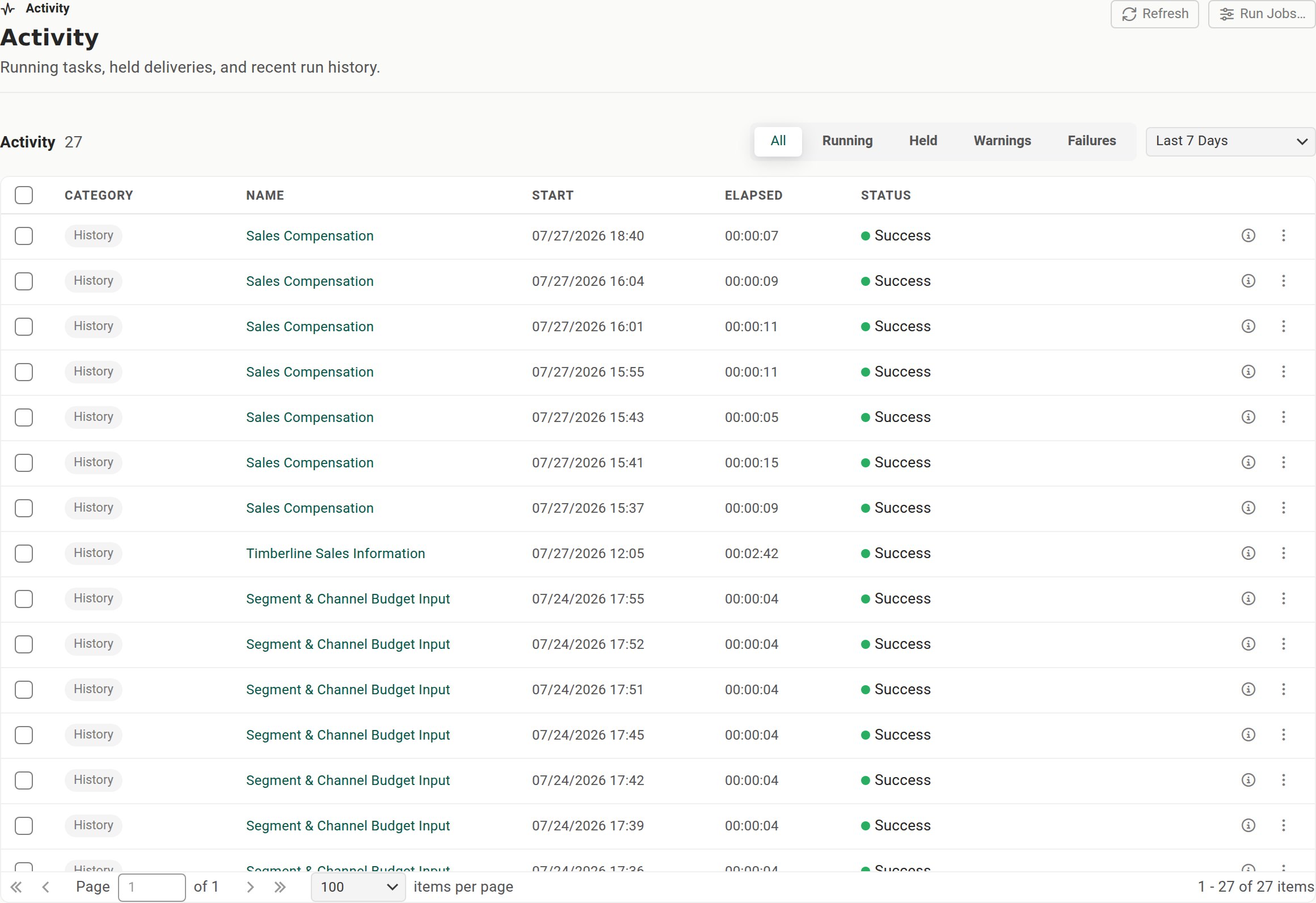
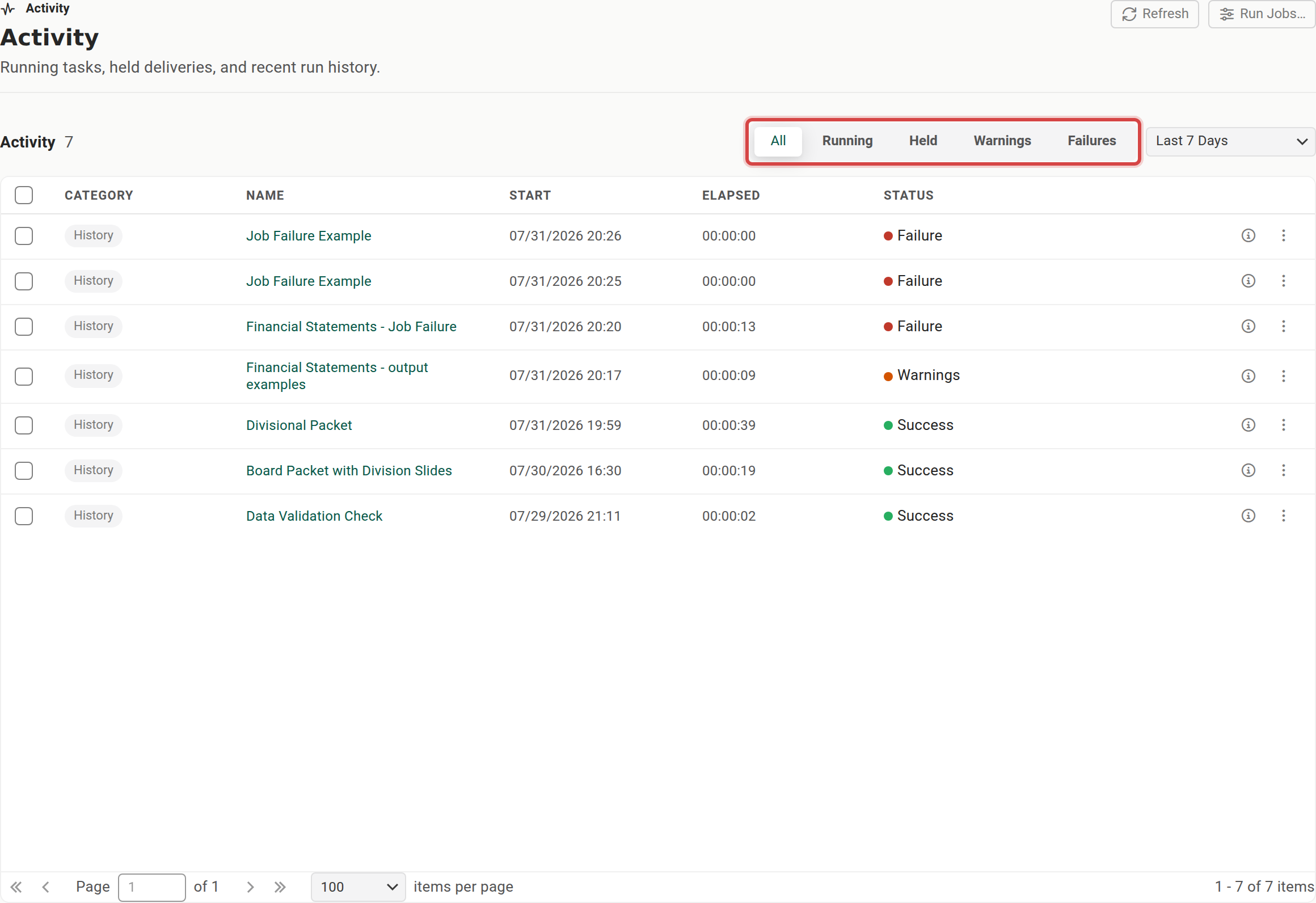
Read run success from a completed History row's status (Success, Warnings, or Failure) or from Run History, not from a Running row's progress text. Mid-run text can include the word "completed" while the job is still going.
Release or cancel a held delivery#
A run made in Hold for Delivery generates its outputs but pauses distribution, so you can review before anything is sent. Held runs appear in the Hold category.
- Review the held output first. Open the Report Viewer or the run's Details to see what was produced.
- On the held row, select Release All to distribute the held outputs and clear the hold. Confirm when prompted. Releasing ships what was already produced; it does not re-run the report.
- To keep the output internal and not send it, open the row's ... menu and select Cancel Hold, which clears the hold without distributing.
Either action moves the run into History.
Cancel a running job#
- On a Running row in your current workspace, select Cancel (stop).
- Confirm in the Cancel Job dialog.
- The run is given 60 seconds to finish and clean up before it is stopped, so a canceled row can stay Running briefly before it clears.
Other row actions#
- Details (History or Hold rows) opens the run's detail, which hosts Details and Diagnostics. See When a job fails.
- Open in Workspace (in the ... menu) jumps to that report's Run History.
- Delete (in the ... menu) removes the run from the list. It asks you to confirm first, and it cannot be undone from Activity.
Review a report's Run History#
Run History is the full record for one report, newest first.
- Open it from a job row's ... menu (Run history), or from a run's Open in Workspace in Activity.
- The run list shows each run's Status and Started time, three performance columns (Elapsed vs baseline, Trend, and Peak mem), then Outputs, Formats, and Delivery. Filter with the All / Success / Warning / Failed pills, each carrying a count. For what the performance columns compare a run against, see Review a run's performance.
- Open a run to inspect its outputs, per-file downloads, Distribution history, and any AI Insights. A failed run shows an error card with Run again and Send logs to support.
- Pin a run to keep it regardless of the retention policy, for example a final period-close run. The retention note on the list states how long runs are kept. Delete run removes the run from the history list; it asks you to confirm, and warns that the run's stored output and execution log go with it.
- If a run you know has finished is not listed, select Refresh in the ... menu. Refresh rebuilds the list from the stored history rather than re-reading what is already in memory, so a completed run whose finish notification went missing appears immediately. The same applies to Refresh in the Report Viewer.
Notes and limits#
- Activity is for authors and administrators. Users do not have access to Activity.
- Activity is the cross-report live view; Run History is the per-report record. To read or download a run's rendered output, use the Report Viewer.
- Deleting a run cannot be undone from Activity or Run History. Neither screen has a restore action. The deleted run's stored output and execution log stay on the server until a background purge removes them, so a run deleted by mistake can sometimes still be recovered, but only as a Reportworq support task and only before the purge runs. Contact Reportworq support promptly if you need one back. To keep a run indefinitely instead, Pin it. See Output retention.
Going deeper. To read, download, or email a run's outputs, see View and download results. If a run failed or warned, see When a job fails. To find out why a run was slow, see Review a run's performance.
Feedback on this page
Comments, questions, requests, or something missing or unclear? Email us - the page you are on is filled in for you.
Email feedback on this pageOr write to support@reportworq.com directly.